Why We Can’t Have Nice Things Part 1: Negative Connotations
Intro and overview
Hydrogen may not be a polar molecule, but in energy it is a very polarizing topic. Despite being one of the most necessary parts of modern society– providing all our fertilizer for agriculture and the chemical reactions for everything from plastics to medicine – it is misunderstand by almost all and hated by most. On the other side of the story, many hydrogen pundits are aggressively unrealistic about what hydrogen can commercially accomplish. Hydrogen has also had blatant frauds (Nikola) and dozens of major companies enter and scale back or leave the sector (Fortestcue, Shell, Woodside). Somewhere in this noise lies the true opportunities for hydrogen in our energy systems to provide more equitable and lower cost clean power.
Unfortunately, the plausible and necessary use cases have been repeatedly derailed ongoing problems of artificial market barriers rather than thermodynamic barriers. For example, Hydrogen energy systems are “scary” for reasons completely unrelated to hydrogen energy, H2 cooperative working groups have been stymied by incumbent insiders to maintain hold on their monopolies, and support has been actively attacked politically to prevent deployment. This is a six part series on structural and political reasons hydrogen has failed to date. The topics are:
The negative image of hydrogen – AKA hydrogen bombs and the Hindenberg are completely unrelated to hydrogen energy
Incumbents acting rationally prevents industry growth
The battery lobby and investors trying to prevent hydrogen from gaining any foothold
Dirty Washington DC power Politics destroying 45V
Dirty Washington DC petty politics for self-enrichment slowing H2
Newcomers to hydrogen lobbying to prevent growth of any other types of hydrogen
These all describe why hydrogen should have succeeded in some places– but continues to fail as the industry shoots itself in the foot at the same time as being kicked in the face by outsiders.
First, we start with connotations that make people afraid of H2 – and compare actual hydrogen safety to gasoline and battery systems.
Fair warning: this article is longer than most (3500+ words) because it was fun to write.
EDIT: yes, there was an accident with a trailer transporting H2 in February. This was not a vehicle incident, but a trailer maintenance incident. We know nothing about it - except that it occurred during a maintenance event. Until we have more details, it is not worth commenting on in the context of the rest of this document. It is likely irrelevant in that the safety features were bypassed and the driver should not have been working on H2. Moreover, the trailer appears to have no ventilation and is in a closed space - which is not best practices and is indeed bad practices.
EDIT 2: A read pointed out that there was a 2018 explosion of a forklift - but it wasn’t from the fuel tank. It was from a leak in the fuel cell that then built up hydrogen in the battery box of the forklift. Compare this, however, to the 18 deaths from lithium ion batteries in NYC alone in 2023.
The core PR problem: fear makes organizing local opposition against hydrogen much more effective – stopping projects dead in their tracks
Some infrastructure is decided at the State level – most power lines are decided by a state commission. The upside is that local opposition can rarely derail these projects, but state level decisions take half a decade. Other infrastructure is decided at a local level – which can move very quickly to either approve or stop a project. New hydrogen use cases are almost entirely local decisions – making local opposition the largest barrier.
Unfortunately, everyone falls prey to misunderstandings and misleading propaganda with hydrogen. As a battery parable, firefighters know a lot about fire – but were surprised again and again when battery electric car fires could not be extinguished. Fire departments know almost nothing about hydrogen and are amongst the most fierce opposition to anything hydrogen. Unfortunately, the surprises with BEVs have made them wary of all new technology, but the association with unrelated hydrogen bombs and the Hindenburg.
The Fire Department of New York and various fire marshals in New Jersey have banned hydrogen vehicles and hydrogen transport from bridges and tunnels. Despite that Sandia National Labs demonstrated that hydrogen is far less of a risk than gasoline and an EU collaboration across 11 countries found that in a ventilated tunnel (pretty much all tunnels), lighter-than-air H2 will rush out the ventilation stacks. BEVs will leave heavier-than-air toxic smoke that will resist being pulled out, stay at ground level, and choke everyone. Gasoline vapors, also heavier than air, will also linger and present fire and explosion risk.
This is summarized below:
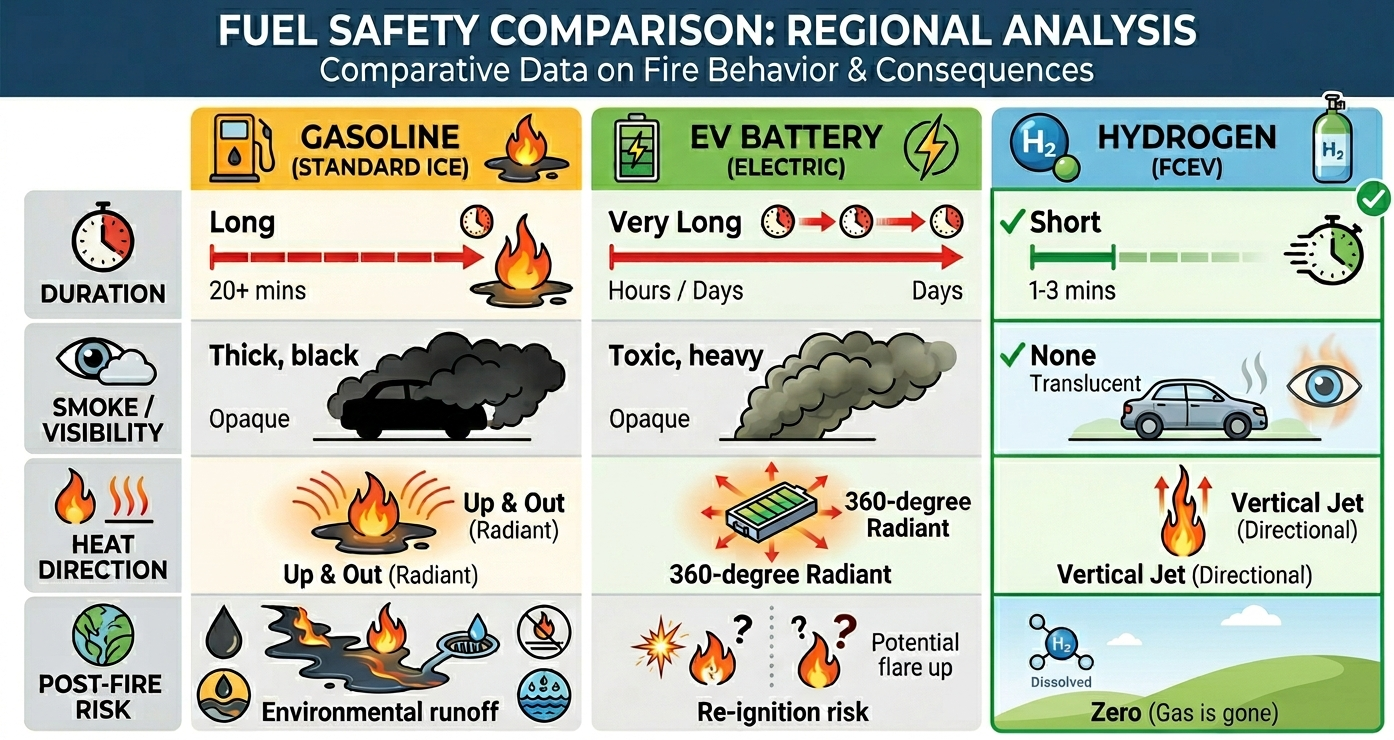
In a modern hydrogen system, risks are lower and managed better than other energy systems, particularly in vehicles. Source: created by CleanEpic, data from various sources
Despite these facts, fire departments across the country have followed suit and worked to ban hydrogen vehicles – often with prodding from lobbyists and activists of other vehicle types.
But Hydrogen is very safe in sturdy containers, can not be a bomb, isn’t the Hindenburg, and with current standards is safer than other energy storage systems
Fun fact: hydrogen burns invisibly. When you look at the picture of the Hindenburg, the flames you see aren’t hydrogen, but are instead the materials of the and wrap. The hydrogen burnt, but the cause was the wrap. In fact, the predecessor to the Hindenburg flew over 1 million miles without incident. Conflating H2 with causing the Hindenburg incident would be the same as saying everycommercial airplane crash was caused by gasoline and nothing else.
Fun fact #2: there are 5000 gas station fires per year in the US. The only state without gas station fires is New Jersey – where the public is not allowed to pump their own gas. While these may not be as wild as the gas station event in Zoolander, gasoline is extremely dangerous and would not be permitted to be in public today if it were developed now.
In practice, modern hydrogen systems are safer than gasoline and BEVs. Gasoline vehicle fires are an order of magnitude more damaging than hydrogen vehicle fires. A hydrogen vehicle fuel tank has never been exploded despite 40,000 being in active operation. Yes, it turned out Trump lied when he said hydrogen cars have exploded. Shown below is a hydrogen car fire (which, again, has never happened in practice) compared to a gasoline car fire.
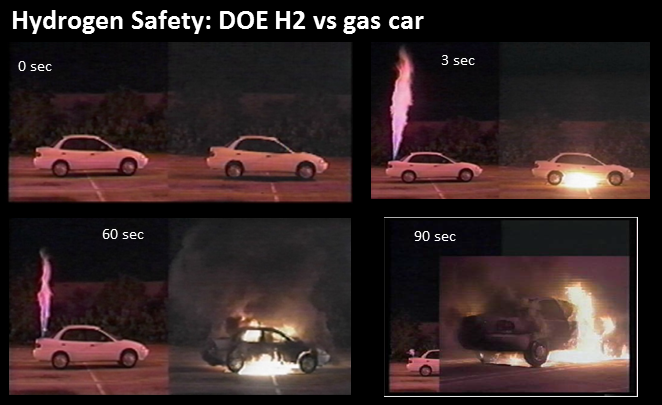
Source: Professor Leachman’s website.
Leaks and fires were purposely started in a vehicle with a hydrogen tank and a vehicle with a gasoline tank. The hydrogen fire vents upward, the gasoline pools on the ground creating a fire underneath the car. 90 seconds later the hydrogen is self-extinguished and the gasoline car is a charred wreck.
Again, this test has never been replicated in practice because hydrogen tanks are simply too difficult to break. In the next section I detail how safe hydrogen is required to be – it is actually nearly impossible to make a hydrogen car leak like this. I encourage you to read more details here at Professor Jacob Leachman’s site – because he already did all the work of pulling this together.
Hydrogen risk is managed by reducing the chance of an event happening
Risk is the chance of an event happening multiplied by the damage caused by the event. So a one-in-a-million event that causes $1M of damage is the same risk as a one-in-billion event that causes $1B of damage. If we can reduce the chance of an event happening, even though the damage would be the same, we have reduced the risk.
Hydrogen has similar level of damage potential as gasoline or batteries, but modern hydrogen systems have far more systems in place to reduce the change of damage, making them far lower risk. Below are the ways that hydrogen risk is far more manageable than other fuel types.
Hydrogen fuel tanks go through a certification process that is many orders of magnitude more rigorous than any other vehicle type
A Bulletproof Fuel Tank
Hydrogen tanks are bulletproof. This is not a figure of speech. A spray of AK47 fire would bounce off an H2 fuel tank without even chipping or denting the tank. Let’s put this “bulletproof tank” in context - in the vast majority of catastrophic accidents, the vehicle's occupants would reach the limit of human survivability long before the hydrogen tank reaches its structural failure point. Humans squish at 50-100 G. Hydrogen tanks are tested to thousands of G. In layman’s terms, anything that can break an H2 fuel tank would have terminally squished a human at 1/20th the force.
Not just bulletproof – they won’t explode under weapons fire that can stop an armored personnel carrier or take down a helicopter
An AK-47 round is too weak for H2 tank tests. To pass vehicle certification, a standard 7.62mm round must not puncture or crack an H2 fuel tank. For reference, withstanding a 7.62mm round is the standard of defense for military grade armor making Hydrogen fuel tanks literally military grade.
The next required test is to upgrade that round to an armor piercing 7.62mm. This round must only pierce the fuel tank, not cause catastrophic failure or explosion. A 7.62mm AP round can punch through a standard vehicle engine block or an armored personnel carrier.
What about rounds that are designed to take out helicopters?
H2 fuel tanks have been tested voluntarily under what should be the most ridiculous condition possible: .50 caliber armor piercing rounds shot at point blank range. Video here. These rounds are designed to stop literally anything other than main battle tanks and trains. The energy of impact would be the equivalent of dropping a 6 foot piece of 1” diameter steel reinforcement bar (rebar) from a 70 story building, except the steel is sharpened to a point the size of a pencil eraser. This is not “worst case scenario” – this is an extreme test that goes far beyond realism to demonstrate how safe these tanks are. It still only manages to punch a hole in the tank – no explosion.
The military tested RPGs and C4
In all of these tests, the researchers struggled and mostly failed to get a fire to start. The hole in the tank creates a “high pressure jet” of pure H2 that extinguishes even the flame from an incendiary round. It chokes it with pure high-pressure hydrogen, blowing out the fire. The hydrogen, much lighter than air, then rushes upward and disperses, precluding flame or explosion risk in all but a few circumstances. Circumstances which would be far more dangerous with gasoline or battery cars.
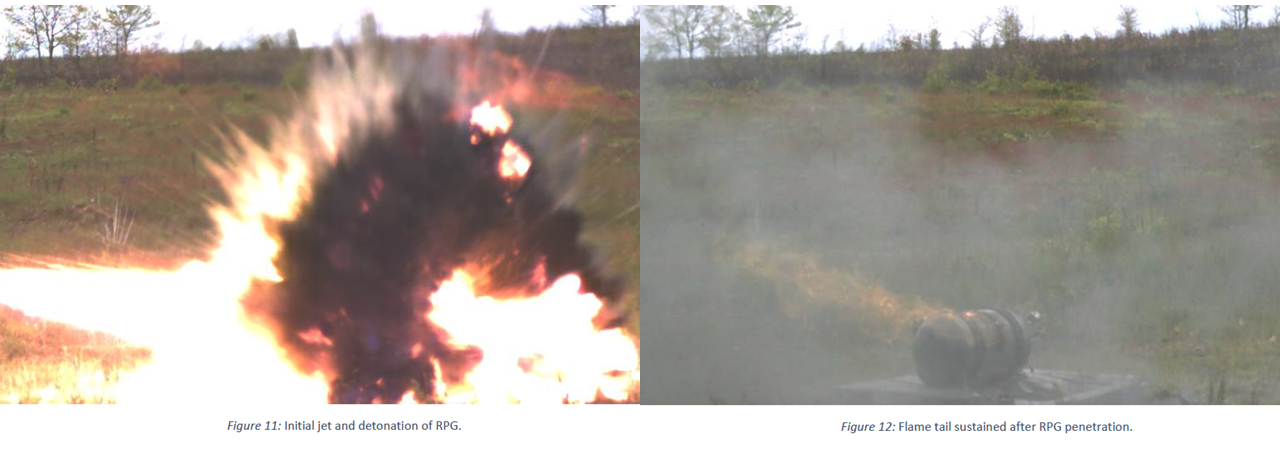
The military succeeded in creating a sustained fire by strapping a rocket propelled grenade to the hydrogen tank and detonating it with C4 explosive. The tank survived. Instead of the tank exploding along with the C4 and rocket, a jet of fire was released and quickly burnt out. Here’s the picture with the initial RPG+C4 explosions (right) and the tank remaining after (left) (also courtesy of Professor Leachman):
What if battery vehicles or gasoline vehicles were subject to these tests?
Any of these bullets would turn a lithium ion car into a fiery mess within a minute that would release toxic fumes, some would create an instead death hazard of fire and toxic smoke. The bigger rounds would start instant fires and small explosions similar to this lithium-ion fire safety training exercise. Lithium ion cells self-heat when pierced, and then create their own oxygen so they can’t be extinguished. Safer Lithium-iron (LFP) batteries, mostly found in low-end cars and stationary power batteries, would get hot enough to create their own oxygen from .50 caliber fire.
Hydrogen fuel tanks are the only battlefield-level tested technology used in a public vehicle, making them one of the safest types of fuel available.
What about real-world collision tests?
In 50mph rear end collisions, car trunk and rear seats were obliterated. The tank between the seat was entirely uncompromised. We squishy humans will catastrophically squish before one of these tanks rupture in an accident.
What about the fittings and tubing in an accident?
These have a burst rating of over 2100 atmospheres. This would be 21km under the ocean – or twice the depth of the Marianas trench. In addition, every hydrogen tank has a “failed closed” solenoid – which means even in the extremely unlikely event a line were ripped away, the tank would close. As soon as the vehicle detects a collision, the valves automatically close.
What if a hydrogen tank is pierced and does leak in an accident? Hydrogen is lighter than air and disperses
This is an extremely unlikely scenario, but the results are shown in the fire test above. Hydrogen escapes up, away from the car. In the event of an accident where a fire starts, diesel[1] and gasoline can pool on the ground and ignite under the car or even spread to other cars. Batteries in battery electric cars can catch on fire and produce far more flames than even a gasoline car.
Hydrogen cars have much less potential energy than gasoline or battery cars – or really any other fuel type
It takes about 600 gallons of water to extinguish a gasoline or diesel passenger vehicle fire. A standard fire truck carries up to 1000 gallons and can easily handle a gasoline car fire.
A battery electric car takes 4500+ gallons of water to extinguish and usually needs to be fully submerged to keep the fire out. 4500 gallons is about what it takes to extinguish an entire single family building on fire. And while the amount of electrical potential in a battery car is lower than a hydrogen car owing to higher conversion efficiency, the thermal potential of the battery materials burning is about 2-3x more than hydrogen.
If a hydrogen fire does start, it creates a directed flame with little smoke that burns out in under a minute. In short, a hydrogen car is almost impossible to make catastrophically leak, and when it does, the hydrogen floats away[2] or burns away in a safer manner than other fires.
Only military vehicles have this level of testing and protection
With impervious tanks and fuel shut-off at the impervious tanks, H2 vehicles use a “proactive” system that contains the fuel energy at storage. BEVs and gasoline cars are “reactive” in that they shut off the flow of fuel and power to the engines, but they cannot contain the energy stored in the fuel tank or batteries. Only military vehicles have proactive systems, whether it is self-healing tanks or active fire extinguishing systems.
But what about the Hindenburg?
NASA and others have shown that the Hindenburg fire was caused by the outer skin of the Hindenburg – which then ignited the hydrogen. The Graf Zeppelin was an earlier version of the Hindenburg that didn’t cut corners the way the Hindenburg did. It flew more than a million miles without incident before being decommissioned. The Hindenburg came out in 1936, three years after the Nazi’s rose to power. The Graf Zeppelin first flew in 1928. It is generally accepted that Nazi cost-cutting resulted in improper bonding of the Hindenburg hull to the outer membrane – allowing it to build up static charge that kicked off the fire.
Hydrogen vehicles have none of the features that started the Hindenburg fire – and any vehicle fire would not extend to the H2. The Hindenburg is functionally unrelated to hydrogen.
What about hydrogen bombs?
A hydrogen bomb is a nuclear fusion reaction – the reaction that occurs in the sun. We cannot create a real fusion reaction outside short of setting off an atomic bomb to start a hydrogen bomb – which uses a type of hydrogen that we can’t get under normal circumstances.
Hydrogen fuel cells use a chemical reaction. A fusion reaction is a million times stronger than a chemical reaction, but it is in an entirely different branch of physics that is impossible to reach via anything related to hydrogen energy.
But what about the accidents that have happened?
While a vehicle hydrogen tank has never exploded, accidents have happened. These accidents pale in comparison to the accidents that have happened with batteries and gasoline, however. I’ll use examples here. Keep in mind that while hydrogen vehicles and energy storage are nascent markets, hydrogen is used and moved in industry in far larger quantities than all energy used in all the battery powered cars in the world combined: at about 3000 terawatt hours of energy are in the 100 million tons of in H2 used annually compared to the 200 terawatt hours estimated used by all electric vehicles annually in the entire globe.
Industrial incidents
Santa Clara – 2019. An untrained, uncertified worker attempted maintenance on a hydrogen trailer, releasing the gas and causing a fire and explosion. The same has happened in industrial settings across the US for nearly every sector. This was not a hydrogen safety issue, this was a human error common in any industry. Direct damage was on the order of $5-$10M.
Battery comparison
In May 2024 the Gateway Energy Storage facility – a lithium ion battery facility, started a fire that would flare up for 14 days. It released toxic gas the entire time, forcing a 600 foot safety perimeter and evicting hundreds of families. Total damage and cleanup was on the order of $50M.
In January 2025 the Vistra Moss Landing battery plant in Monterey County started a fire – much larger than the Gateway Energy Storage battery plant fire in 2024. The fire lasted for three days, requiring evacuation of 1500 residents while it belched toxic fumes that engulfed the region. 30 days later it self-reignited. It took 8 more months to de-energize and remove all the damaged batteries. The total damage and cleanup was on the order of $500M.
Vehicle incidents
Bakerfield, CA - July 2023. A fire and explosion at Golden Empire Transit. A leaky valve on a rooftop storage tank caused hydrogen buildup. Norwegian company Hexagon Purus improperly fit the safety valves (Hexagon is not as good as Toyota at this stuff), causing the safety valve of the tank to pop out. Unlike passenger vehicles, these buses were not yet designed to vent (New Flyer isn’t as good at this stuff as Toyota) and H2 built up. It destroyed the $1M bus and the $3M fueling station. No one was injured.
Battery comparison – H2 is still safer
This H2 bus fire was rookie league compared to the recent SEPTA BEV fire in Philadelphia in which a BEV bus caught fire and destroyed 40 other buses. Firefighters could not put out the buses and had to tear down fences to create fire breaks, letting the buses burn themselves out while constantly emitting toxic fumes to the surrounding environment. This was about $35M of buses if new (they were slated for scrap – reducing their value in real terms). Shelter-in-place rules went into place for several blocks for 24 hours owing to extreme amounts of pollution from the burn. Compared to the hydrogen event, which was easily contained to a single vehicle and was over quickly, the scale and scope of a battery disaster is much larger owing to the flammability and uncontrollable nature of battery fires.
Other examples
While there many other examples –
Fatal Korean events
a hydrogen explosion at a research facility in 2019 in Korea that caused 2 deaths and $33M of damage compared to:
a battery factory fire in Korea that killed 23 people in 2024 and caused $30M in damage. It would have been much higher monetary damages, but 18 of the 23 deaths were Chinese citizens so they payout to their families was much lower (yes, this a truly awful statistic)
Vehicle-caused garage fires and accidents
there are zero incidents from the tens of thousands of fuel-cell passenger vehicles and forklifts
compared to a Korea BEV fire in a garage that spread, caused an estimated $100M of damage, 23 hospitalizations, and unlivable conditions for 500 people for a week;
In the hydrogen examples above, all were learning moments with critical safety features added and the events have largely never repeated. In the battery examples, the events keep repeating and the causes aren’t addressed.
Don’t forget the gas comparison!
I also remind you of the 5000 gas station fires that happen in the US every year – which have gone unaddressed everywhere except New Jersey.
There are also fires in parking lots every few years that destroy thousands of gasoline cars in each fire.
Can someone bypass these safety measures and make hydrogen dangerous?
Yes, but the same amount of effort would cause far more damage with a battery or gasoline vehicle – recall the BEV garage garage fire above and the Oklahoma City Bombing with diesel.
Hydrogen can build up in unventilated spaces and explode – but similar risks have actually happened in garages with both electric and gas vehicles
Hydrogen that leaks and is captured in a tight space can explode. Most parking garages are required to have ventilation to prevent carbon monoxide poisoning – so they will mostly vent H2. Battery and gasoline cars have already caused far worse than this, however.
Conclusion: hydrogen is very safe and improving – and safer than alternatives in nearly all cases. But we still can’t have nice things.
The over 25,000 hydrogen forklifts and tens of thousands of hydrogen light duty vehicles uel tanks in operation have never had a hydrogen incident. Yet fire departments and local opposition worldwide have their fears stoked to block deployment.
Hydrogen systems are still in their infancy relative to other energy systems. Unlike other energy systems, they are subjected to military-grade testing. The incidents that have happened have largely been much more limited in damage compared to other energy systems, and in nearly all cases created safety equipment or protocols that will prevent similar issues in the future. The same cannot be said for other energy systems – which have repeated and ongoing issues.
It turns out that hydrogen in its current form is one of the safest energy systems. And is getting safer all the time.
Nonetheless, the fear of hydrogen will hold it back. Some opposition is simply ignorant – and can’t understand that Hindenburg and Hydrogen Bombs have nothing to do with hydrogen energy. Most, however, are concerted misdirection efforts to keep hydrogen from expanding. Opposition to hydrogen comes from many sides – vehicle manufacturers that know they won’t be able to figure out hydrogen, electric vehicle investors and owners that think hydrogen will reduce their investment values, parts of the oil and gas industry that want to maintain status quo, and even existing hydrogen companies that don’t want new markets to open because they can’t compete. Ultimately, the fear of hydrogen is stoked by both opponents of and allies within hydrogen to prevent new energy systems from developing. I’ll be writing about that in the next four or five articles.
[1] It is very hard to start a diesel fire – it requires that diesel spill on hot exhaust or engine to create the vapor that will burn. It is possible, but diesel is one of the safest fuels
[2] In the event that it is an enclosed space, like a tunnel, the amount of potential energy in the hydrogen for a vehicle is far less than any other vehicle type. National labs modeling has shown that hydrogen vehicles pose the least danger of catastrophic damage of vehicles – with hydrogen being the only fuel type to not have enough energy to melt and damage the concrete in a tunnel
